- +971 56 918 6895
- sales@globaltechuae.com
- Salah Al Din Road, Deira, Dubai-UAE

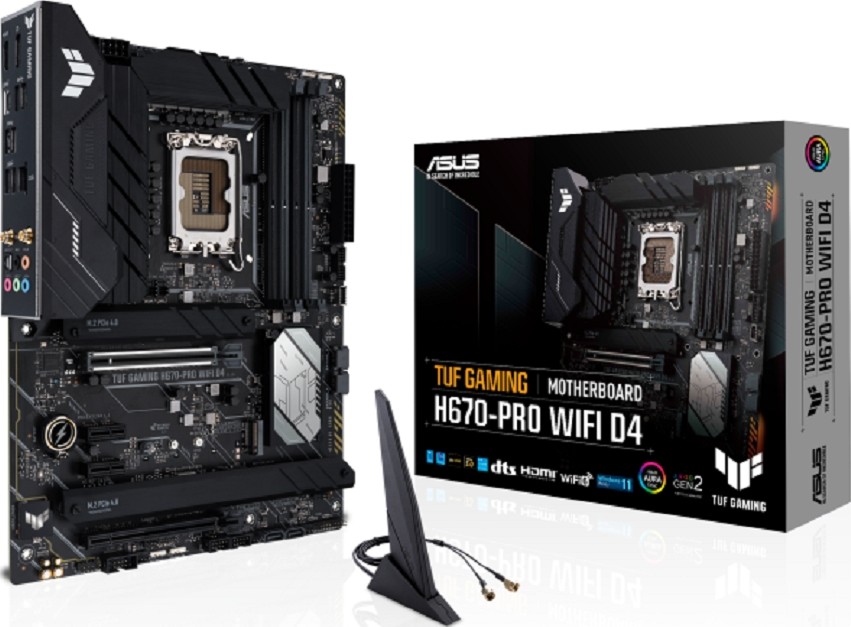
Asus Tuf Gaming H670-Pro Wifi D4 ATX Motherboard, 12th Gen LGA 1700 Socket, DDR4, PCIe 5.0, 4 PCIe 4.0 M.2 slots, 14+1 DrMOS, 2.5Gb Ethernet, DisplayPort, HDMI, USB 3.2, Aura Sync | 90MB1900-M0EAY0
د.إ 951.23
| Brand | ASUS |
|---|---|
| Model | Tuf Gaming H670-Pro Wifi D4 |
14
People watching this product now!
Description
Intel® H670 (LGA 1700) ATX motherboard with PCIe 5.0 slot, four PCIe 4.0 M.2 slots, 14+1 DrMOS, Intel® 2.5Gb Ethernet, DisplayPort, HDMI, front USB 3.2 Gen 1 Type-C®, Aura Sync
- Intel® LGA 1700 socket: Ready for 12th Gen Intel® processors
- Enhanced power solution: 14+1 DrMOS, six-layer PCB, 8+4 ProCool sockets, military-grade TUF components and Digi+ VRM for maximum durability
- Comprehensive cooling: Enlarged VRM heatsink, Stack Cool 3+, M.2 heatsinks, PCH heatsink, hybrid fan headers and Fan Xpert 4 utility
- Latest connectivity: PCIe 5.0 slot, PCIe 4.0 M.2 slots, rear USB 3.2 Gen 2×2 Type-C®, front panel header for USB 3.2 Gen 1 Type-C® and Thunderbolt 4™ support
- Made for online gaming: Intel® WiFi 6, Intel®2.5Gb Ethernet, TUF LANGuard
- Two-way AI Noise-Cancelation: Reduces background noise from the microphone and audio output for crystal-clear communication in games or video conferences

Durable. Stable. Reliable.
ASUS TUF GAMING H670-PRO WIFI D4 takes all the essential elements of the latest Intel® processors and combines them with game-ready features and proven durability. Engineered with military-grade components, an upgraded power solution and a comprehensive cooling system, this motherboard offers rock-solid and stable performance for marathon gaming. Aesthetically, TUF GAMING H670-PRO WIFI D4 sports the new TUF Gaming logo and incorporates simple geometric design elements to reflect the dependability and stability that defines the TUF Gaming series.

DrMOS
The onboard VRMs feature 14+1 DrMOS power stages that combine high-side and low-side MOSFETs and drivers into a single package, delivering the power and efficiency that 12th Gen Intel Core processors demand.The power stages are each rated to handle 50 amperes to provide stable performance for current and future Intel processors.
Related products

-17%
ASUS Prime H470M-PLUS, CSM LGA1200 (Intel 10th Gen) Micro-ATX Motherboard, HDMI, Dual M.2, Intel 1Gb LAN, USB 3.2 Gen 2 Type-C and ASUS Control Center Express | 90MB1350-M0EAY0
In stock
Original price was: د.إ 633.44.د.إ 523.64Current price is: د.إ 523.64.
SKU:
GTC55176

-4%
MSI MPG Z490 Gaming Carbon WiFi, ATX, LGA 1200 Socket, 10th Gen. Intel Core, DDR4, SLI/CF, Dual M.2 Slots, USB 3.2 Gen 2, Wi-Fi 6, DP/HDMI, Mystic Light RGB | 911-7C73-001
In stock
Original price was: د.إ 1,264.79.د.إ 1,214.11Current price is: د.إ 1,214.11.
SKU:
GTC55166


-4%
MSI MEG Z490I Unify Gaming Motherboard, LGA 1200, Intel 10th Gen, M.2, USB 3.2 Gen 2, DDR4, Wi-Fi 6, CFX, Gigabit LAN, Thunderbolt 3, Mini-ITX | 911-7C77-002 / 911-7C77-001
In stock
Original price was: د.إ 1,254.22.د.إ 1,200.38Current price is: د.إ 1,200.38.
SKU:
GTC55164

-12%
GIGABYTE Z490 AORUS Master, Intel LGA1200, ATX, Intel 2.5G LAN, 3xM.2 Thermal Guard, SATA 6Gb/s, USB 3.2 Gen 2, Intel Wi-Fi 6, ESS Sabre DAC, Fins Array II | Z490 AORUS Master
In stock
Original price was: د.إ 1,923.59.د.إ 1,689.19Current price is: د.إ 1,689.19.
SKU:
GTC55163

-1%
GIGABYTE Z490 AORUS Ultra, Intel LGA1200, ATX, Intel 2.5G LAN, 3xM.2 Thermal Guard, SATA 6Gb/s, USB 3.2 Gen 2/Intel Wi-Fi 6, Realtek ALC1220-VB, RGB Fusion | Z490 AORUS ULTRA
In stock
Original price was: د.إ 1,486.50.د.إ 1,476.99Current price is: د.إ 1,476.99.
SKU:
GTC55162

-8%
Asus ROG Maximus XII Formula Z490 (WiFi 6), LGA 1200, (Intel 10th Gen) ATX Gaming Motherboard | 90MB1370-M0EAY0
In stock
Original price was: د.إ 2,422.97.د.إ 2,217.08Current price is: د.إ 2,217.08.
SKU:
GTC55160

-5%
MSI MEG Z490 ACE Gaming Motherboard ATX, 10th Gen Intel Core, LGA 1200 Socket, SLI/CF, Triple M.2 Slots, USB 3.2 Gen 2, Wi-Fi 6, Mystic Light RGB | 911-7C71-004/911-7C71-005
In stock
Original price was: د.إ 1,942.60.د.إ 1,847.55Current price is: د.إ 1,847.55.
SKU:
GTC55155
