- +971 56 918 6895
- sales@globaltechuae.com
- Salah Al Din Road, Deira, Dubai-UAE

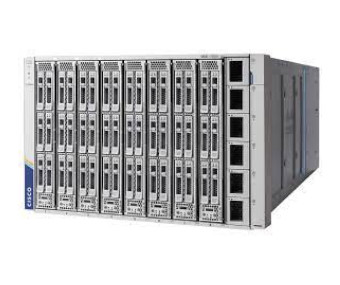
Cisco UCS X9508 Chassis specifications and price
| Brand | Cisco |
|---|
12
People watching this product now!
Description
Cisco UCS X9508 Chassis Models:
| Model | Description |
| Cisco UCSX-M6-MLB | UCSX M6 Modular Server and CHASSIS MLB |
| Cisco UCSX-9508-U | UCS X9508 Chassis Configured |
| Cisco UCSX-9508-CH | DISTI: UCS X9508 Chassis |
Cisco UCS X9508 Chassis Specification:
| Item | Specifications | |
| Height | 12.05 in (30.6 cm); 7 RU | |
| Width | 17.55 (44.6 cm); fits standard 19-inch square-hole rack | |
| Depth | 34.81 in (88.4 cm) | |
| Node slots | 8 | |
| Intelligent Fabric Module (IFM) | 2 x Cisco UCS 9108 Intelligent Fabric Module with 8x 25G SFP28 ports | |
| X-Fabric module slot | 2x Cisco UCS X-Fabric module rear blank slots (for future expansion) | |
| Fan module | 4 x 100mm hot-swappable dual rotor fans | |
| Power supply bays | 6 | |
| Power supplies | 2800W Titanium certified | |
| Input voltage | 100 to 127 V AC
200 to 240V AC |
|
| Maximum input VA | 3200 VA at 230 VAC | |
| Maximum output power per power supply | 2800 W @200-240 VAC Nominal
1400 W @100-127 VAC Nominal |
|
| Frequency | 50 to 60 Hz | |
| Output voltage | 54 VDC | |
| Power connector | IEC320 C20 | |
| Power redundancy | Non redundant, N+1, N+2, and Grid (N+N) | |
| Power Entry Module (PEM) | 2x PEM for AC inputs, PEM1 (PSU1,2,3), PEM2 (PSU4,5,6) | |
| Management | Cisco Intersight software (SaaS, Virtual Appliance, and Private Virtual Appliance) | |
| Temperature: operating | 50 to 95°F (10 to 35°C) (as altitude increases, maximum temperature decreases by 1°C per 300m) | |
| Temperature: non operating | -40 to 149°F (-40 to 65°C); maximum altitude is 40,000 ft | |
| Humidity: operating | 10% to 90% non condensing, 28°C max | |
| Humidity: non operating | 5% to 93% non condensing, 38°C max | |
| Altitude: operating | 0 to 10,000 ft (0 to 3000m); maximum ambient temperature decreases by 1°C per 300m | |
| Altitude: non operating | 40,000 ft (12,000m) | |
| Sound pressure level | 83 dBA – at normal operating temperature | |
Cisco UCS X9508 Chassis Features:
- 7-Rack-Unit (7RU) chassis has 8x front-facing flexible slots. These can house a combination of compute nodes and a pool of future I/O resources that may include GPU accelerators, disk storage, and nonvolatile memory.
- 2x Cisco UCS 9108 Intelligent Fabric Modules (IFMs) at the top of the chassis that connect the chassis to upstream Cisco UCS 6400 Series Fabric Interconnects. Each IFM features
- Up to 100 Gbps of unified fabric connectivity per compute node
- 8x 25-Gbps SFP28 uplink ports. The unified fabric carries management traffic to the Cisco Intersight cloud-operations platform, Fiber Channel over Ethernet (FCoE) traffic, and production Ethernet traffic to the fabric interconnects.
- At the bottom are slots ready to house future I/O modules that can flexibly connect the compute modules with I/O devices. We call this connectivity Cisco UCS X-Fabric technology because “X” is a variable that can evolve with new technology developments.
- Six 2800W Power Supply Units (PSUs) provide 54V power to the chassis with N, N+1, and N+N redundancy. A higher voltage allows efficient power delivery with less copper and reduced power loss.
- Efficient, 4x100mm, dual counter-rotating fans deliver industry-leading airflow and power efficiency. Optimized thermal algorithms enable different cooling modes to best support the network environment. Cooling is modular so that future enhancements can potentially handle open- or closed-loop liquid cooling to support even higher-power processors.
Cisco UCS X9508 Chassis Benefits:
- Simplify with cloud-operated infrastructure: We move management from the network into the cloud so that you can respond at the speed and scale of your business and manage all your infrastructures. You can shape Cisco UCS X-Series Modular System resources to workload requirements with the Cisco Intersight cloud-operations platform. You can integrate third-party devices including storage from NetApp, Pure Storage, and Hitachi. And you gain intelligent visualization, optimization, and orchestration for all your applications and infrastructure.
- Simplify with an adaptable system designed for modern applications: Today’s cloud-native, hybrid applications are inherently unpredictable. They get deployed and redeployed as part of an iterative DevOps practice. Requirements change often, and you need a system that doesn’t lock you into one set of resources when you find that you need another. For hybrid applications and a range of traditional data center applications, you can consolidate onto a single platform that combines the density and efficiency of blade servers with the expandability of rack servers. The result: better performance, automation, and efficiency.
- Simplify with a system engineered for the future: Embrace emerging technology and reduce risk with a modular system designed to support future generations of processors, storage, nonvolatile memory, accelerators, and interconnects. Gone is the need to purchase, configure, maintain, power, and cool discrete management modules and servers. Cloud-based management is kept up to date automatically with a constant stream of new capabilities delivered by the Intersight software-as-a-service model.
You must be logged in to post a review.


Reviews
There are no reviews yet.